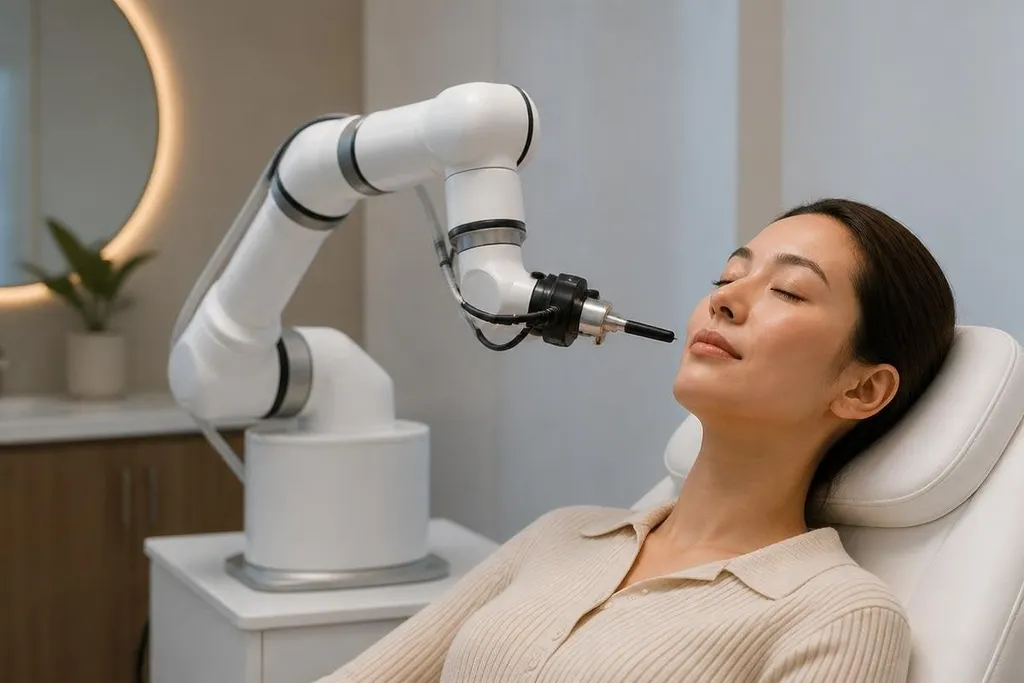
A beauty robot has to work close to skin, hair, eyes, and hands. That makes the job harder than moving a box across a factory floor. AI helps these systems see body shape, adjust motion, and respond to small changes, but it doesn't remove the need for careful design or human supervision.
- Cameras can map skin, hair, or a client’s position before a task starts.
- Machine learning can adjust pressure, speed, and motion during a treatment.
- Safety, consent, and repeatable results still limit where these robots can work.
What AI adds to the robot
A traditional robot follows set points. If the arm moves to the same position each time, it expects the object or person to be in the same place too. Beauty work rarely offers that level of order. Heads move, hair changes shape, and skin presents different colors, textures, and conditions.
Computer vision gives the robot a way to measure those changes. Cameras or depth sensors can locate a face, map a section of skin, or track the position of a hand. The software then turns that information into movement for an arm, nozzle, scanner, or other tool.
Machine learning can help with pattern matching. A system may compare an image with a set of labeled examples to sort visible skin features or find the edge of a hairline. That result is only a guide. Lighting, makeup, hair texture, and skin tone can affect what the camera sees, so the robot needs checks before it acts.
Where beauty robots may help
The clearest uses are tasks with repeated motions and a small working area. A robot could hold a camera at a steady distance for skin imaging, move a tool along a planned path, or repeat a measured application across several sections of hair.
That repeatability may help a technician record the same area over time. A later scan can use similar lighting, distance, and camera angle, which makes changes easier to compare. The robot still needs a person to decide what those changes mean and what action makes sense.
AI can also adjust movement during a task. Force sensing can tell the robot when a tool presses against skin. The control system can slow the arm or stop it if the measured force passes a set limit. In a salon or clinic, that response matters because a small position error can affect a person directly.
A beauty robot’s safety claim needs force readings and stop response recorded with the test setting. Robot24.com robotics coverage can place those facts beside the salon or clinic task, where the robot works close to skin and a person.
The hard problems are close to the customer
Skin and hair differ across clients, and the robot has to work safely across that range.
A model trained on narrow image data may perform less reliably on skin tones, hair types, or lighting conditions missing from its training set. A good interface should show uncertainty and ask for help instead of hiding the problem.
The robot also needs a safe response when the client moves. That can mean reducing speed near the face, keeping force low, or stopping when a hand enters the work area. A human operator needs a clear view of the task and a fast way to stop the system.
Privacy adds another concern. Cameras may collect face images, skin scans, or records tied to a client. A salon or clinic needs to explain what it stores, how long it keeps the data, and who can access it. AI does not answer those questions by itself.
I'd be cautious about any beauty robot that promises a fully automatic treatment without showing its failure cases. A polished demo can prove that one sequence worked; it can't prove that the system handles every client safely.
A practical buying and testing checklist
Before you approve a beauty robot for a salon, clinic, or lab, check these points:
- Define the task: name the exact treatment or measurement the robot will perform.
- Check the sensing: ask how it handles motion, lighting changes, skin tones, and hair types.
- Test the stop system: confirm that an operator can halt the arm before contact becomes harmful.
- Review the data plan: identify what images or scans are stored and who can view them.
- Measure repeatability: run the same task across different people and record the error.
- Set the human role: decide when a technician must approve, correct, or stop the process.
What happens next
The useful path for beauty robots is likely to start with support tasks, measurements, and controlled tool movements. Those jobs give AI a narrow target and leave final decisions with a trained person.
Fully automatic care faces a higher bar because the customer is also the safety boundary. Until makers publish results across varied users and show how the robot behaves when its sensors are unsure, supervised automation is the safer bet.